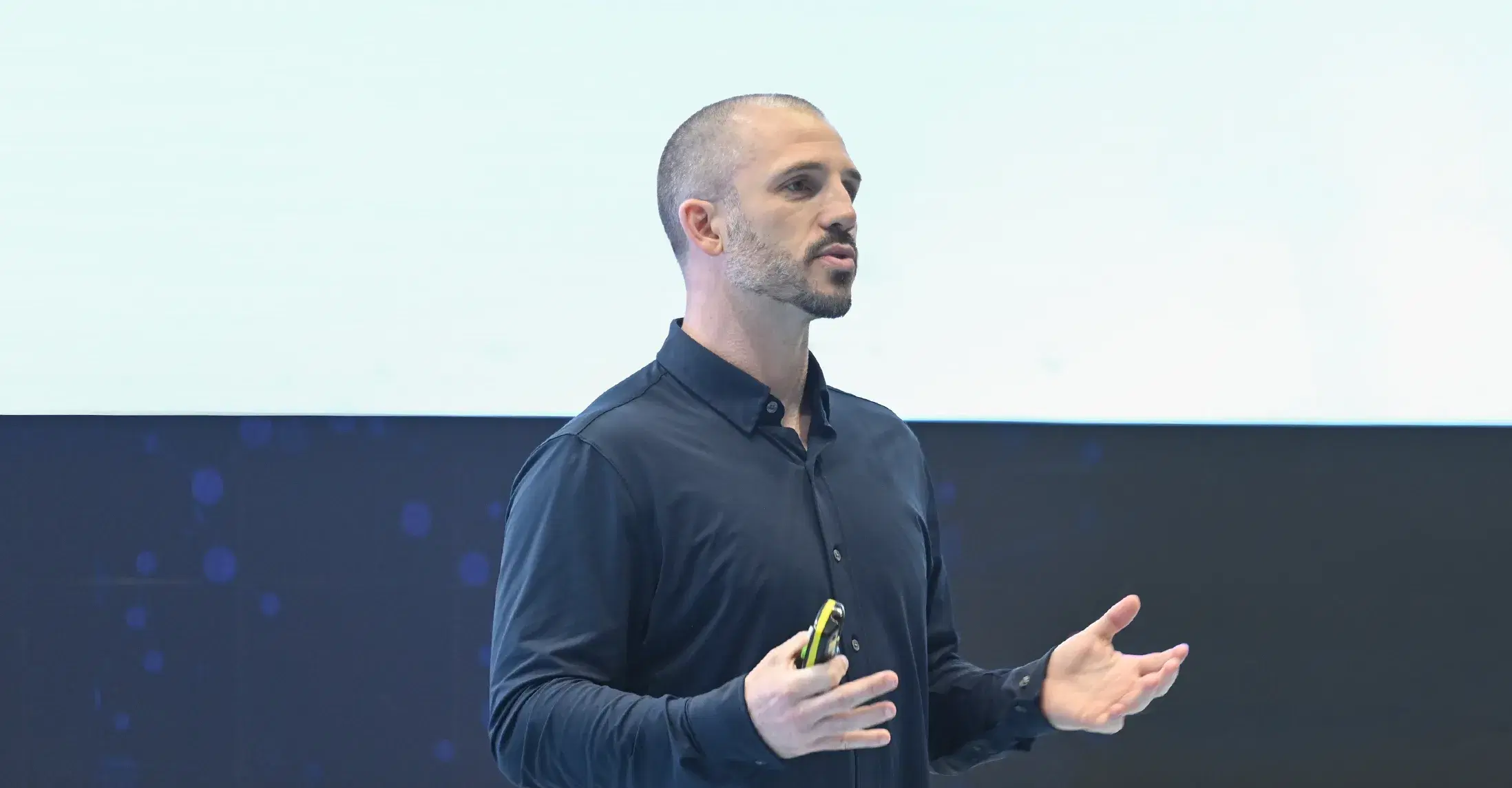
Get to knowDr. Andy Galpin
As a professor and scientist of human performance, Dr. Andy Galpin holds a PhD in Human Bioenergetics, an MS in Human Movement Sciences, and is a Fellow of the National Strength and Conditioning Association — with more than 100 peer-reviewed publications and presentations to his name.
For two decades, Andy has worked with some of the world's most decorated athletes — All-Stars, All-Pros, MVPs, Cy Young winners, Olympic gold medalists, world champions, and record-breakers across the NFL, MLB, NBA, NHL, UFC, PGA, boxing, the Olympics, and military special forces.
Beyond his academic and coaching work, Andy is a co-founder of BioMolecular Athlete, Vitality Blueprint, Absolute Rest, & Perform Media. He hosts the podcast Perform with Dr. Andy Galpin.
Origins
Andy Galpin spent the first 18 years of his life in rural Rochester, Washington — a small farming town in the southwest corner of the state — and grew up steeped in Pacific Northwest sports culture as a devoted fan of the Seahawks, Huskies, and Mariners (with lasting grief over the Sonics and grudging acceptance of the Kraken). He was a genuine multi-sport athlete throughout his childhood and teen years, playing football, basketball, baseball, and track & field, and was, by his own modest account, "reasonably good at them all."
His blue-collar upbringing shaped his work ethic as much as his athletic one: he worked at a grocery store and gas station, baled hay on local farms, picked at the blueberry farm, and put in long days on road-construction crews alongside his father, brother, and, on occasion, his grandfather.
The defining moment of his early life came around age 14, when he picked up his first barbell. Something clicked immediately — a recognition that lifting weights wasn't a passing teenage interest but a lifelong pursuit. That early instinct would eventually become the foundation of a career dedicated to understanding what makes the human body adapt, recover, and perform.
Becoming a Scientist
Galpin took his self-described "limited athletic talents" to Linfield College in Oregon, where he played football — winning a Division III National Championship in 2004 and earning two-time captain honors on the team's "All-Ugly" squad — and graduated in 2005 with a B.S. in Exercise Science. A coveted post-graduation internship as a strength & conditioning coach in Tempe, Arizona, dropped him into a facility working with active MLB and NFL players. It was a thrilling first taste of the elite-sport world (he had never met a famous athlete before), but it also clarified something important: the grind of a full-time coaching life wasn't for him. He wanted to understand why training worked, not just how to deliver it.
So he enrolled at the University of Memphis and earned his M.S. in Human Movement Sciences in 2008, working under Dr. Andy Fry — a lifetime-achievement-award winner and one of the most respected figures in the field. Those two years were his first true immersion in the scientific method as applied to human performance, and they lit a fuse. During his master's, he also took up competitive Olympic weightlifting (placing 7th at the 2007 National Championships) and discovered combat sports, despite having no prior background or interest in either — beginnings of what would become decades of competitive lifting, MMA, and Brazilian Jiu-Jitsu.
Still hungry to understand muscle at its most fundamental level, he moved on to Ball State University, where he spent four years studying the structure and function of human skeletal muscle at the single-cell level. He earned his Ph.D. in Human Bioenergetics in 2011. Throughout his doctoral work, he continued competing in weightlifting, MMA, and BJJ — and, largely unbeknownst to his academic advisors, was already building a side practice coaching pro fighters, Division I basketball players, and distance runners. That combination of bench science, applied training, and elite-athlete coaching would become his signature.
Cal State Fullerton Years
In 2011, Galpin joined the faculty at California State University, Fullerton, recruited by another lifetime-achievement-award winner, Dr. Lee Brown. Brown's Center for Sport Performance was, at the time, arguably the most productive applied performance lab in the country, and the vision for hiring Galpin was deliberate: pair Brown's deeply applied strength & conditioning expertise with Galpin's molecular and physiological background to create something neither could build alone. The blend worked. Galpin founded and ran the Biochemistry and Molecular Exercise Physiology Laboratory (MEPL) from scratch and became the first scientist to bring human muscle biopsies to the entire 23-campus California State University system — a methodological breakthrough that allowed his lab to ask questions about elite human performance that few academic settings could address.
Over 13 years at CSUF, he was tenured in 2016 and promoted to Full Professor in 2020, eventually serving as Co-Director of the Center for Sport Performance alongside Brown. He taught senior- and graduate-level courses in Strength & Conditioning, Program Design, Muscle Physiology, Applied S&C, and Nutrition for Performance — designing classes that consistently filled every semester and covered material he says he hasn't seen replicated elsewhere. His mentorship became another defining contribution: dozens of undergraduate and graduate students passed through MEPL, many winning prestigious awards (including Graduate Student of the Year for the College), earning their own PhDs, and going on to launch their own labs. He also founded and operated one of the most popular collegiate weightlifting clubs in the country.
While building his academic program, Galpin's private coaching practice exploded. He worked with Olympic gold medalists, All-Pros, All-Stars, Cy Young winners, MVPs, and world-record holders across virtually every major sport — NFL, NBA, MLB, NHL, UFC, wrestling, powerlifting, and Olympic weightlifting — coaching men and women, veterans and emerging savants alike. He earned his CSCS*D and NSCA-CPT*D credentials, became active in both the National Strength and Conditioning Association and the American College of Sports Medicine, served as a reviewer or editor for more than 20 peer-reviewed journals, and co-authored the best-selling book Unplugged. By the time he left CSUF, his lab's work had been featured in the New York Times, Forbes, the Journal of Applied Physiology, the Huberman Lab Podcast, and the Joe Rogan Experience, among others.
Parker University & The Human Performance Center
On August 15, 2024, Parker University announced Galpin's appointment as Executive Director of the new Human Performance Center, a Center of Excellence on the university's Dallas, Texas campus. He joined as a tenured Full Professor with a mandate to lead one of the most ambitious human-performance facility builds in higher education: a 64,000-square-foot center designed from the ground up to integrate research, education, and public-facing services under a single roof.
The vision is deliberately three-pronged. Academically, the HPC will host undergraduate and graduate degree programs in strength, conditioning, and human performance science — complementing Parker's existing graduate offerings in clinical neuroscience, strength and human performance, and functional nutrition. Scientifically, it will house cutting-edge research infrastructure capable of supporting the kind of molecular, physiological, and applied work Galpin pioneered at CSUF — but at significantly greater scale. And operationally, it will be open to the public, offering human performance services to athletes and everyday people alike. In Parker President Dr. William E. Morgan's words, the HPC is intended to be "a beacon of advanced research and practical solutions for optimizing health and performance." Slated to open in 2025, the center represents Galpin's most ambitious institutional undertaking to date — and a chance to build, on a blank slate, the kind of integrated science-meets-application environment he spent his entire career proving was possible.
Research Interests
Galpin's scientific portfolio is intentionally broad: he studies whatever he considers relevant to human performance, which in his definition runs from the molecular machinery inside a single muscle fiber all the way up to whole-organism interventions like breathwork, sleep, and nutrition. With more than 100 peer-reviewed publications and presentations and over 1,700 citations to his work, his published output reflects that range.
Methodologically, he has pioneered innovative techniques for measuring signaling proteins in individual human muscle fibers — pushing the field's resolution down to the single-cell level. He has personally performed hundreds of muscle biopsies over his career, an unusually high count for an academic researcher. His published work spans how heavy resistance bands alter mechanical loading patterns in the deadlift, the muscle-fiber characteristics of elite male and female (Olympic) weightlifters, the effects of intermittent dieting on athletes, epigenetic responses to acute resistance exercise in trained versus sedentary men, post-activation performance enhancement in Olympic weightlifting, the skeletal-muscle adaptations of elite powerlifters (including those using anabolic-androgenic steroids), and discordant exercise habits in monozygotic twins separated by 30 years of training history.
Current and forward-looking projects from his group span precision sleep optimization, biomolecular profiling of elite athletes, muscle quantification across the human lifespan, and interventions for enhancing brain function. His work has appeared in the Journal of Strength and Conditioning Research, the Journal of Applied Physiology, Sports, the International Journal of Sports Science & Coaching, and other top journals — and in mainstream media outlets including the New York Times, Forbes, the Huberman Lab Podcast, and the Joe Rogan Experience. Underneath the methodological diversity is a consistent throughline: he wants to know, in mechanistic detail, what separates elite performance from average — and what tools can move any individual closer to their physiological ceiling.
Mission
Galpin organizes his work around four interlocking missions that, together, define how he chooses what to spend his time on.
His personal mission is to help people achieve their personal best across a broad domain and definition of performance — by doing impactful research, building tools and services that allow real-world implementation, and sharing the resulting knowledge in a digestible format. The word broadmatters: he's as interested in helping a beginner take a first useful step as he is in helping a world champion squeeze out a final fraction of a percent.
His education mission is to enhance the human condition by providing the world with free, entertaining, and useful human performance education. This impulse — born from his frustration that university teaching was always boxed into specific formats, prerequisites, and class sizes — drove him to build a popular YouTube channel and his "5 Minute / 25 Minute / 55 Minute Physiology" content series. In late 2024, after years of resistance and direct encouragement from his friend Dr. Andrew Huberman, he launched the Perform with Dr. Andy Galpin podcast, which deliberately breaks the standard format: Season 1 took nearly a year to write, contains 10 episodes, and features no guests, with deep-dive topics including how to use and interpret bloodwork, genetic testing, concussion recovery, VO2 max and endurance, and sleep optimization. He also co-founded the education company BioMolecular Athlete with Dan Garner and Collin Castellaw to deliver in-person seminars, online courses, and longer-form instructional content for those who want more than the free material.
His scientific mission is to help all humans achieve peak performance by defining, developing, and disseminating knowledge on the science of physiological excellence — the formal version of what the HPC, MEPL, and his publication record have been building toward for two decades.
His coaching mission is to serve the world's highest performers in a way that helps them reach their true physiological potential, delivered through the Arete program at RAPID Health & Performance — a fully immersive, highly personalized service built around advanced diagnostics, a multidisciplinary expert team, and protocols tailored to each client's individual molecular signature. Notably, Arete is open to anyone, not just elite athletes: longevity-focused executives, serious recreational lifters, and regular fitness enthusiasts all work through the same system. Galpin is also a co-founder of Vitality Blueprint (blood testing) and Absolute Rest (sleep coaching) — companies built to operationalize the science his lab and others have produced.
The unifying thread across all four missions is the same instinct that started with a 14-year-old kid in Rochester picking up a barbell for the first time: a conviction that human physiology is more malleable than most people believe, and that the right combination of science, coaching, and accessible education can help anyone — from a complete beginner to a world record holder — get measurably closer to their personal best.
Speaking Engagements
For speaking & media inquiries, please use our speaking form and we'll get back to you soon.
Submit a RequestDisclosures
A complete, current accounting of Dr. Galpin's financial relationships, advisory positions, and other commercial affiliations.
Disclosures